
Best Government Jobs After Graduation in India: Exams, Salary, Eligibility & Career Options
Published 26 Sept 2026
By Naukritrail Team
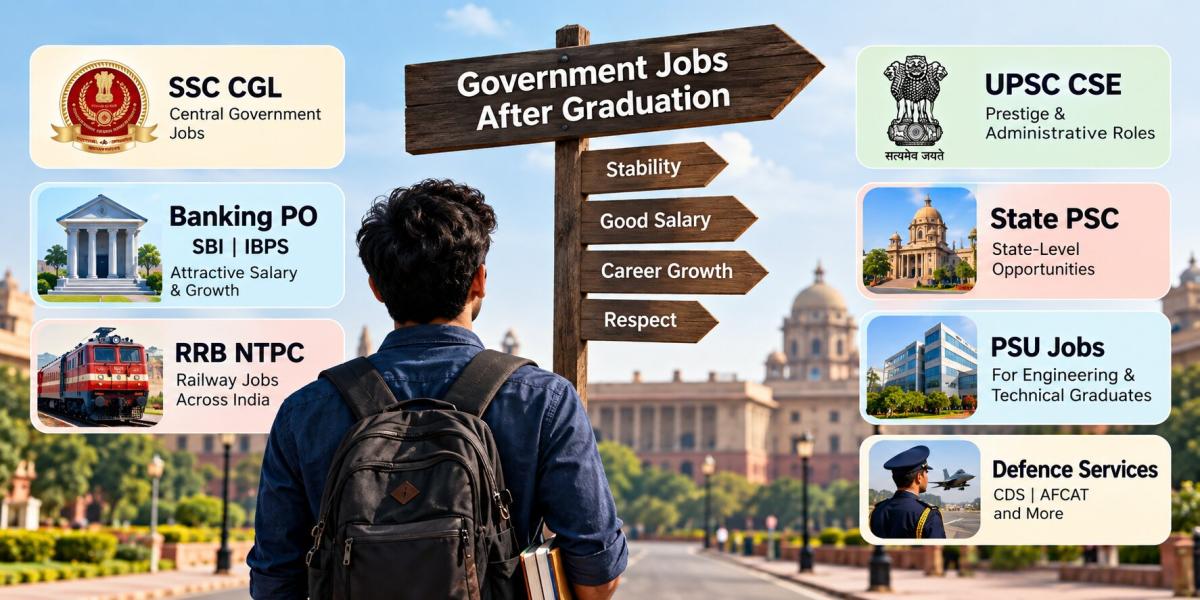
Graduation opens the door to a wide range of government career opportunities in India. From administrative services and banking to railways, public-sector companies and state government departments, graduates can choose from several competitive examinations depending on their interests, abilities and long-term career plans.
However, choosing the right exam is often more difficult than finding opportunities.
Should you prepare for UPSC Civil Services? Is SSC CGL a better option for a stable office career? Would a banking job provide faster career growth? Or should you focus on a State Public Service Commission examination to improve your chances of working closer to home?
This guide explains the major government job options available after graduation, along with eligibility, approximate salary, selection process and practical factors that can help you decide where to focus your preparation.
Quick Overview
For graduates looking at major competitive examinations:
- SSC CGL provides access to numerous Group B and Group C positions in Central Government departments.
- Bank PO examinations such as SBI PO and IBPS PO can provide attractive starting salaries and relatively fast career progression.
- UPSC Civil Services Examination leads to prestigious administrative services but requires extensive preparation and has intense competition.
- RRB NTPC offers graduate-level opportunities in Indian Railways.
- State PSC examinations are suitable for candidates interested in administrative careers within a particular state.
- A large portion of the syllabus for SSC, banking and railway examinations overlaps, making combined preparation possible.
Why Government Jobs Remain Popular Among Graduates
Government employment continues to attract graduates because it generally offers a structured career path, regulated pay scales, allowances, retirement benefits and long-term employment stability.
Central Government positions generally follow pay levels prescribed under the applicable Central Pay Commission structure. Depending on the post, employees may also receive benefits such as Dearness Allowance, House Rent Allowance, leave-related benefits, medical facilities and employer contributions toward retirement schemes.
But government employment is not one single type of career.
The working environment of a bank officer can be very different from that of an SSC-selected Central Government employee, railway official or civil servant. Candidates should therefore examine the actual job profile rather than selecting an examination only because it is popular.
Top Government Career Options After Graduation
1. SSC Combined Graduate Level Examination
The SSC Combined Graduate Level examination, commonly known as SSC CGL, is one of the most widely attempted examinations among graduates.
It is conducted for recruitment to various Group B and Group C positions in Central Government ministries and departments.
Depending on vacancies and examination notifications, posts may include roles such as:
- Assistant Section Officer
- Auditor
- Accountant
- Income Tax-related positions
- Inspector-level posts
- Other departmental positions
Who Should Consider SSC CGL?
SSC CGL can suit candidates who prefer:
- Office-oriented government jobs
- A relatively structured working schedule
- Central Government employment
- Opportunities across different ministries and departments
Quantitative Aptitude, English, Reasoning and General Awareness form important parts of the preparation, which also creates syllabus overlap with several other competitive examinations.
2. Banking Jobs Through IBPS and SBI
Public-sector banking continues to be another major career route for graduates.
Important examinations include:
- IBPS PO
- SBI PO
- IBPS Clerk and other banking recruitment examinations
A Probationary Officer usually begins in an operational and managerial role and may handle customer service, branch operations, loans, compliance and other banking functions.
Banking careers can offer quicker promotions than many traditional government departments, although the work environment can also involve customer-facing responsibilities, business targets and transfers.
Banking Jobs May Suit You If You:
- Are comfortable interacting with customers
- Enjoy numerical and analytical work
- Want relatively faster career progression
- Can work comfortably in a target-oriented environment
- Are open to transfers during your career
Starting compensation varies depending on the bank, location and allowances. The source material notes that PO-level in-hand compensation in metro locations can cross ₹60,000 in some cases.
3. UPSC Civil Services Examination
The UPSC Civil Services Examination (CSE) is the route to services such as IAS, IPS and several other Group A and Group B Central Services.
The examination generally includes:
- Preliminary Examination
- Main Examination
- Personality Test/Interview
UPSC requires substantially broader preparation than most graduate-level examinations.
Candidates must develop knowledge across subjects such as history, polity, geography, economy, current affairs, ethics and their chosen optional subject.
UPSC Can Be Suitable for Candidates Who:
- Have a strong interest in public administration
- Are comfortable with extensive reading
- Have good analytical and writing ability
- Can commit to long-term preparation
- Accept a high level of competition
Candidates should also consider keeping an alternative examination in their preparation plan because UPSC preparation can take several examination cycles.
4. Railway Jobs Through RRB NTPC
Indian Railways recruits graduates for various positions through examinations such as RRB NTPC.
Depending on the recruitment notification, opportunities can include administrative, commercial, clerical and operational roles.
Railway employment is particularly attractive to candidates interested in a large government organisation with positions spread across the country.
Some railway roles may involve shift duties or operational responsibilities, so candidates should check the exact job description before selecting their post preferences.
5. State Public Service Commission Examinations
Every state conducts recruitment through its respective Public Service Commission.
Examples include state civil services and other graduate-level administrative positions.
State PSC examinations are especially relevant for candidates who prefer:
- Working within their home state
- State administrative services
- State-specific departments
- Careers where knowledge of regional issues may be useful
The examination structure commonly includes prelims, mains and an interview, although the exact pattern varies by state.
Candidates should always refer to the notification issued by the relevant commission because eligibility, age limits, syllabus and reservation rules differ between states.
6. PSU Jobs for Engineering and Professional Graduates
Public Sector Undertakings also recruit graduates, especially candidates from engineering and technical backgrounds.
Recruitment may happen through:
- GATE scores
- Independent recruitment examinations
- Campus recruitment
- Interviews and technical assessments
PSU jobs can be attractive because compensation packages for technical positions may be higher than several conventional graduate-level government posts.
Engineering graduates preparing for GATE should therefore also monitor PSU recruitment notifications.
7. Defence Services After Graduation
Graduates interested in the Armed Forces can explore examinations such as:
- CDS
- AFCAT
- Other officer recruitment programmes
Unlike most desk-oriented government examinations, defence careers require candidates to meet physical and medical standards in addition to academic eligibility.
They are best suited to candidates interested in discipline, leadership and a service-oriented career.
Government Exams After Graduation: Quick Comparison
| Examination | Conducting Organisation | Typical Qualification | Major Selection Stages | Approx. Starting Income* |
|---|---|---|---|---|
| UPSC CSE | UPSC | Graduation | Prelims, Mains, Interview | ₹56,100 basic pay onwards depending on service |
| SSC CGL | Staff Selection Commission | Graduation | Tier-based examination | Around ₹35,000–₹80,000+ depending on post/location |
| SBI/IBPS PO | SBI / IBPS | Graduation | Prelims, Mains, Interview/other stages | Around ₹60,000–₹75,000+ in some metro postings |
| RRB NTPC | Railway Recruitment Boards | Graduation for graduate-level posts | CBT stages and applicable skill tests | Around ₹35,000–₹60,000+ |
| State PSC | Respective State PSC | Graduation | Prelims, Mains, Interview | Varies considerably by state |
*These figures should only be treated as approximate indicators. Actual salary depends on pay level, posting city, allowances, deductions and revisions in applicable pay structures. Always verify compensation from the latest official recruitment notification.
Eligibility for Government Jobs After Graduation
For many general graduate-level examinations, candidates need a bachelor's degree from a recognised university.
However, eligibility differs from one recruitment to another.
Certain positions may require:
- A specific graduation subject
- Engineering qualifications
- Professional qualifications
- Minimum marks
- Physical standards
- Medical standards
- Additional certificates or licences
Age limits also vary by examination and post.
Several recruitment examinations provide age relaxation for categories such as SC, ST, OBC, PwBD and eligible ex-servicemen according to applicable rules.
Therefore, candidates should never assume that holding a bachelor's degree automatically makes them eligible for every graduate-level vacancy. The detailed eligibility section of the official notification should always be checked before applying.
Can You Prepare for Multiple Government Exams Together?
Yes.
In fact, graduates can often prepare for more than one examination because several competitive exams share common subjects.
The most common overlapping areas include:
- Quantitative Aptitude
- Reasoning Ability
- English
- General Awareness
- Current Affairs
For example, someone preparing for SSC CGL may already be building many of the skills required for banking and railway examinations.
The specialised part can then be added separately.
Banking candidates may need additional banking and financial awareness, while SSC candidates may require deeper preparation in some areas of mathematics and General Studies.
This makes a primary exam + backup exam strategy practical for many candidates.
Salary and Benefits in Government Jobs
Salary should not be judged by basic pay alone.
Government employees can receive several components depending on the organisation and posting.
These may include:
- Basic Pay
- Dearness Allowance
- House Rent Allowance
- Transport-related allowances
- Medical benefits
- Leave benefits
- Retirement contributions
- Department-specific allowances
Central Government posts follow designated pay levels, while state government departments follow their respective pay structures.
Public-sector banks and PSUs operate under their own compensation frameworks.
Consequently, two candidates with similar basic salaries may receive different in-hand amounts depending on location and allowances.
Work-Life Balance: Government Jobs Are Not All the Same
Many candidates choose government employment expecting every role to provide fixed hours and low work pressure.
That is not always the case.
SSC Jobs
Many departmental positions are office-oriented and may provide relatively predictable working hours.
Banking Jobs
Bank officers frequently interact with customers and may handle business targets, branch operations and transfers.
Railway Jobs
The working environment varies widely. Some positions are desk-oriented while others involve operational duties or shifts.
Civil Services
Administrative roles can involve significant responsibilities, public interaction, field postings and long working hours depending on the assignment.
State Government Jobs
These may provide greater geographical stability for candidates wanting to remain within a particular state, although transfer policies differ by department.
Candidates should research the actual duties of the post instead of making their decision purely on salary or the name of the examination.
How to Decide Which Government Exam Is Right for You
There is no single government examination that is ideal for everyone.
Your decision should depend on your abilities and career priorities.
If You Are Strong in Quantitative Aptitude
Consider:
- SSC CGL
- Banking examinations
- RRB examinations
If You Enjoy Current Affairs and Descriptive Writing
Consider:
- UPSC Civil Services
- State PSC examinations
If You Are an Engineering Graduate
Consider:
- GATE
- PSU recruitment
- SSC technical recruitments
- Engineering services where eligible
If Staying Closer to Home Matters
Consider:
- State PSC examinations
- State government recruitment
- Region-specific vacancies
If Faster Career Progression Is Important
Banking careers may deserve closer examination because officer-level recruitment can provide a structured promotional path.
The best approach is usually to identify one main examination and then select a second exam that shares a substantial portion of the same syllabus.
Common Mistakes Graduates Make While Preparing
Preparing for Every Exam
Applying for ten different examinations without a clear strategy often leads to fragmented preparation.
Focus on examinations with similar syllabi.
Choosing Only by Salary
A higher salary does not automatically mean a better career for you.
Posting location, transfers, workload, promotion prospects and job responsibilities also matter.
Depending Entirely on One Difficult Examination
A long-term examination such as UPSC can remain your main target, but keeping another realistic option can reduce career risk.
Ignoring Official Notifications
Eligibility and examination patterns can change.
Always treat the official recruitment notification as the final authority.
Waiting for Perfect Preparation
Competitive examination preparation improves through repeated practice, mock tests and previous-year papers. Waiting until you feel completely prepared before attempting an examination can unnecessarily delay progress.
Frequently Asked Questions
Which government exams can I take after graduation?
Graduates can consider examinations such as SSC CGL, UPSC Civil Services, IBPS PO, SBI PO, RRB NTPC, State PSC examinations, defence officer examinations and eligible PSU recruitments.
Can graduates from any stream apply for SSC CGL?
Many SSC CGL posts accept graduates from any recognised discipline. However, some positions can carry additional academic requirements. Candidates should verify the relevant notification.
Can I prepare for banking and SSC together?
Yes. Both examinations contain considerable overlap in Quantitative Aptitude, Reasoning and English, although their question patterns and specialised sections differ.
Which government jobs offer good salaries after graduation?
Officer-level banking roles, certain SSC positions, Civil Services and PSU appointments can offer competitive compensation. Exact figures depend on the organisation, position, city and allowances.
Do government jobs guarantee posting in my home town?
No. Posting depends on the organisation, vacancy availability, examination rank, preferences and transfer rules.
Is UPSC the only route to a respected government career?
No. Central Government departments, banking organisations, railways, PSUs and state services also offer positions carrying substantial responsibilities and long-term career opportunities.
A Practical Preparation Strategy
Instead of beginning with the question, “Which is the biggest government exam?”, start with:
“Which examination matches my abilities and the kind of career I actually want?”
Then follow a simple approach:
Step 1: Select one primary examination.
Step 2: Identify another exam with maximum syllabus overlap.
Step 3: Build strong fundamentals in Quant, Reasoning, English and General Awareness where applicable.
Step 4: Solve previous-year papers.
Step 5: Take timed mock tests regularly.
Step 6: Track only relevant recruitment notifications.
Step 7: Review your performance after every examination cycle and adjust your strategy accordingly.
Final Words
Government jobs after graduation are not limited to UPSC or SSC. Banking, railways, state services, defence and public-sector enterprises collectively provide thousands of career opportunities across different job profiles.
The important decision is not simply whether you want a government job.
You need to decide what kind of government career fits you.
Someone looking for structured departmental work may prefer SSC. Someone interested in financial services and quicker promotions may explore banking. Candidates attracted to administration and public policy may consider UPSC or State PSC examinations, while technical graduates should also evaluate GATE and PSU opportunities.
Choose your primary target carefully, keep a sensible backup examination, and take advantage of overlapping syllabi wherever possible.
Most importantly, before applying for any vacancy, check the latest notification issued by the recruiting authority for eligibility, age limit, vacancies, examination pattern, salary and important dates.